THE UNSPOKEN TABOO OF ART
OR WHY THE UNINTELLIGIBLE IS CRUCIAL FOR ANNIHILATION OF CASTE
Piyush Kashyap
To return the motherland her labourers and soldiers, the sudras must procreate more of themselves.
In caste-essentialism, creation of life from womb is the only relevant form of creation. To reproduce an ontologically predetermined sudra from themselves, the purpose of creation is subsumed by servitude and warmongering. While the oppressor castes occupy privileges to knowledge, power, and capital, the oppressed castes are meant to serve, and serve only. Caste system categorises the working masses as “sudra”, meaning knowledge-less menials, or people who are nothing but servants by nature and cosmic destiny. What the sudras create by their labour is not considered creation, but service [1]. To disenfranchise the authorship of sudras, that is, to create the ontology of workers as knowledge-less menials, a cultural total relation of work and knowledge is severed. Across all sections in the total of caste-civilisation, aspects of work and knowledge are dissociated from each-other. While of course, work is knowledge and knowledge is work; in caste-society, knowledge and work don’t intersect with each-other, nor do they amount to each other. If reality itself, or thinking about reality, or making real, is considered as a form of work, what this dissociation of work and knowledge achieves is a general failure of knowing from experience. To this end, for the sake of oppressing the working masses, caste-civilisation in total, constitutes itself in a dissociative lack of reality.
The caste system keeps some workers outside culture but inside caste-society, while others are kept outside culture and society both. Different forms of work and their materiality are graded at different levels of impurity and menial-ness. The inequality is graded, and the nature and amount of oppression faced by various worker castes varies widely [2]. While different forms of work are placed at different levels of hierarchy, all forms of work and their workers are considered outside culture, and thus marginalised as different levels of sudra, but sudra nonetheless. While constitutionally outlawed, caste remains omnipresent in Indian society and culture. What is popularly known as Hinduism, grounds the caste system theologically and culturally, among other means, through celebration of mythic war and violence, transcendental disembodiment of the human self and intelligence, and dematerialisation of nature and the world [3]. Caste-oppressed people themselves practice caste. They act as oppressors to castes below them, sustaining the structures of caste-oppression at every grade of inequality. In strict caste-categorical terms, determined by birth in a sudra caste, sudras are neither totally oppressed, nor total oppressors. While sudras lead the problem of being oppressed-oppressors, the problem of caste-oppressed people practicing caste, extends beyond and below the sudra caste-category also. Even the most caste-oppressed groups may practice caste, to exclude and oppress those further below their grade of caste-inequality. Here, I am using the term “sudra” beyond its strict caste-categorical containment to signify all caste-oppressed people that practice caste themselves, and are thus, trapped in the ontology of ‘knowledge-less menials’. This essay however, does not intend to shame them for being trapped, neither does it absolve them of their ignorance. Rather, this essay is an attempt to understand how the sudraverse is sustained through a historical and ongoing erasure of cultural agency, and how acceptance of experienced unintelligibility can counter the totality of caste. I have grown through the trauma of becoming anti-caste at an early age in a sudra family, society, and nation, and while this trauma informs my research, my theorisation is not based on that anger.
It is important to the hegemony that the workers must never be acknowledged as creators. It is also important to the hegemony that the sudras must fight for, and propagate, what oppresses them. The servitude of sudras extends to being pawns in the propagation and sustenance of their own oppression. Many sudras take pride in calling themselves ‘foot soldiers’ of the fascistic Hindutva movement [4], whose foundational texts explicitly revere the ancient caste laws [5]. Sudras’ acceptance of caste-system can be partly explained by an affinity to preserve their own caste-power, no matter how insignificant and low in the structure of graded inequality. But there is also, the dissociative lack of reality, that essentiates from the hegemonic exclusion of working masses from the notion of culture, and this point is often ignored because culture itself is rarely understood as having a totalising effect on what reality can be. The very ontologisation of workers as sudras depends on how caste-society thinks of ‘creation’, because in order to mark the creation of workers as productions of labour devoid of knowledge, a cultural total understanding of knowledge (or knowing) is dissociated from the practice of work. Reality does not contain oppression, rather, it is oppression that structures a lack of reality; that is, if we are to understand the action of becoming real as intersections of experience and expression, we recognise that reality itself is a form of work, and when aspects of work and knowledge are dissociated, the work of making and becoming real is unrecognised, creating a lack of reality. Majority demographics of Indians are sudras, whether measured in strict caste-categorical terms, or through the amount of support Hindutva fascism has [6]. The term sudra colloquially means ‘nothing’, and thus it can be said that majority of Indians are nothing. The vast majority is dissociated from its own presence, and absent from its own possibility of reality. The problem of caste thus cannot be limited to only visible and immediately intelligible forms of oppression.
While the notion of creation is constrained to the practicality of being useful to the oppressor, thoughts are decreed as effects of theologically mandated metaphysical entities. The theology is strictly monitored by the oppressor castes, particularly by the Brahmin caste that places themselves at the highest position in the hierarchy. The oppressed castes have no authority over theology, and when they assert otherwise, they are punished through unconstitutional means [7].
While the role of apparent labour may be briefly acknowledged, the notion of ‘creation’ as ‘making of a thing which the enclosed caste-society hasn’t experienced yet’ has no registration. The oppressor wants to preserve the state of things as they are, while the oppressed have no option but to fight for change. For the oppressed, when experience and intelligibility (or possibilities of expression) don’t intersect, it becomes crucial to experiment and invent; the ‘new’ becomes necessary. Which is why, it becomes important for the hegemony to obscure the very possibility of ‘new’, by refusing to recognise anything that is not pre-existent in caste reality. The essentialist understanding of creation as pro-creation, substantiates the meaning of creation as making of a “new” that is always inherently same as its pre-existing predecessor, like a child from parents of the same caste, expected to have inherited the caste-nature of their parents. Society and family are relentlessly paranoid about their complicity to caste and religion, forcing their children to abide strictly to the codes of tradition, alienating any possibility of new beyond the deterministic boundary of caste. Even when the ‘new’ is not universally new, that is, it is already available to world-sense somewhere else on the globe, it is still denied, because anything not doctrinally present in caste and religion is given no ontological existence [8].
There are explicit taboos in caste society, regarding notions of purity, norms of exclusion and segregation, and rules regarding who can be touched or not. In their fight for equality and dignity, when the oppressed break these taboos, the oppressor often responds with aggression and violence to reinstate the caste status quo. But the taboo on creating un-traditionally, or ‘new’, beyond the limitations of duty determined by caste-society, is rarely spoken of. The taboo on freedom of creation remains unspoken, because the very category of agency of creation is not recognised by the hegemony. Even popular anti-caste discourse focuses on visible atrocities of caste, while the majoritarian mass of the caste system is sustained by non-recognition of agency and authorship of the oppressed. At the level of mundane, this unspoken taboo maintains that the thoughts and experiences of the oppressed remain unrecognised, finding no category of existence in the caste-society of duty and complicity.
To ground the non-recognition of agency within the sudra-self, caste-theology transcendentalises the notions of self and cognition, deeming agency and volition as subservient to theologically governed metaphysical entities. The metaphysical principle of “brahman” is regarded as the ultimate eternal source of everything, including the material and cognitive [9], and the caste of “brahmin” has supreme control on the theology that constructs this metaphysics. Nature is subsumed by the term “prakriti” which in brahmanical language, refers to a metaphysical entity that sources the productive efficiency of Nature, but which also, determines the inherent ‘nature’ of all matter including the human [10]. The self also, is transcendentalised by an eternal soul that only wears the appearance of this body in this life [11]. While the oppressed suffer from exploitation of the oppressor, the reason for their suffering is attributed to non-compliance to caste in this or previous life. Thus, every aspect of life and nature is disembodied and dematerialised, and made subservient to theologically mandated metaphysical constructs dictated by caste hegemony. The other-worldly notions of self and cognition disembody and distance the human from their own experience, imagination, thought, and other social and personal practices of agency and volition. In other words, faculties of existence and becoming, like self, senses, thought, and consciousness, are all dissociated from feelings and reasons. This transcendental disembodiment and metaphysical dematerialisation grounds the casteist dissociation of work and knowledge ideologically. The dissociation perpetuates itself through the internalised beliefs of the sudras who never works the real, and never becomes real.
Absence of the self hides behind festive celebrations of mythical wars and contemporary communal antagonisms. Though caste is a peacetime form of oppression, where the oppressed are not actively killed en masse but are rather put to servitude; the ethos of war is always silently implicit in caste-society. Since, thousands of years, oppressor castes have been robbing the oppressed of their equitable share of resources, producing an image of a world condemned to perpetual scarcity. This manufactured material crisis has reduced life to subsistence, creating a paranoia for resources. To hide the exploitative role of oppressor castes in manufacturing scarcity for the oppressed, hegemony propagates a culture of war. Hindutva fascism foregrounds particular myths from the diversity of Hinduism, that have to do with war and violence. Historically, caste-hegemony has achieved this normalisation of war as the natural state of human civilisation, by manufacturing a major part of the religion of Hinduism on the myths of war and violence, between good and evil. The festive spectacle of mythical wars masks the manufactured material scarcity as natural condition of the world. Hindu epics ground aspects of everyday wisdom, ethics, and duties on myths of war [12], turning the crisis of war into religious, and thus socio-cultural consciousness. From history to present, scenes of mythical war have been aestheticised through idols, prints, television drama, costume performances, and ritualised storytelling; making them experiential and participatory. The aspect of war is further made socially immediate through a relentless and aggressive polarisation of Indian society, majorly through cultural production. Hindutva produces songs, movies, social-media content, and even fictional “news” [13] to antagonise non-hindus (who follow a different kind of caste system), and anti-caste communities, as enemies of the nation. The spectacle of festivals and worship grounded upon myths of epic war, and the more contemporary Hindutva polarisation and production of intra-social antagonism, embeds the idea of war deep within the mundane. War and complicity complement each-other. War grounds the need for the apparent hindu-unity, which is the unity across various hindu caste groups, producing the complicity under which various sudra caste-groups occupy their positions as foot-soldiers of the very ideological structure that oppresses them. This war also essentiates the notion of creation as procreation of more and more sudras from themselves, to reproduce more and more pawns for the propaganda. Ethos of war masks the crisis of impoverishment in the dissociated mundane, making violence the only graspable aspect of reality.
Antagonism and violence against minorities, particularly Muslims, Christians, Dalits (most oppressed castes), and Adivasis (people of indigenous cultures), that stems from Hindutva-Nationalism’s widespread hate campaign forms the evident bare face of this reality [14]. While anti-Hindutva discourse criticises the complicity of sudras and the hate and violence against minorities, it fails to criticise the dissociation of work and knowledge, and erasure of agency, that reduces the majority to a state of ontological absence. Neglecting the importance of cultural agency, particularly for the masses, popular discourse fails to discern the missing mundane. Raising no questions about the disavowal of workers as authors of the world, and uncritical of the institution of the family and natalism, popular discourse also fails to recognise the essentialisation of creation as procreation. It is this unrecognised absence that hegemony pervades with existential paranoia and thence, war and complicity.
The essentialisation of creation as procreation is reinforced by a deep reverence for motherhood, propagated by worship of mother goddesses. Hinduism transcendentalises aspects of nature like land, rivers, or incoming of seasons, most often as divine feminine. In Hindu-India, which is mother-India, every woman is by default a “devi” which means “goddess”, but which implicitly means “mother”, as all goddesses are predominantly signified as “mothers” even when mythologically, beyond representing nature, they might be blood-thirsty warriors, scholars, or artists. The mythification of nature as mother enables an incessant exploitation of nature driven by the belief that ‘a mother is always giving’. The cow is revered as holy mother, only to extract from it, its milk. Notion of womanhood is reduced to motherhood, which is divine but servile, and open to unquestionable exploitation. Even the subordinate patriarchal position of ‘wife’ is not highlighted as much, because in the notion of wife, there is a risk of love and camaraderie. Holy rivers like Ganga and Yamuna that are worshipped directly as divine mothers, are badly polluted, but people still take holy baths in them and perform rituals dipped in their waters. Some even drink this polluted water as auspicious gift of mother river. While the devotees can obviously smell the stench and see the toxicity of the polluted waters, they are ideologically dissociated from the bare facts [15]. The evasion of human accountability in exploiting Nature is also an extended symptom of the erasure of human authorship.
Like motherhood for women, the category of divine but servile exists for men as well. The war epic of Ramayana which was chosen by Hindutva to hide caste under the appearance of hindu-unity was chosen so, because it has a monkey god who is devotedly servile to the oppressor caste hindu king. Sold as sacred prints, two images from the epic are particularly famous as calendar style prints. In the first image, devised from the work of a celebrated Indian modernist painter and print-maker, the monkey god is kneeling in front of the oppressor caste human king, and in the second image, whose author is unknown, both are hugging [16]. While there are many versions of Ramayana, as far as I could check, there are no explicit mentions of the monkey god kneeling in front of the human king. The epic portrays the devotion and servitude of the monkey god, but the absolute image of him kneeling is an artistic invention. Through these artistic renditions, the message is clear: you can be a friend only if you bend the knee.
Though Hinduism has some place for transgender women (but which does not entirely cancel the oppression against them) it has no place for other non-binary genders. In the vast mix of Hindustani myths, we may find instances of homo-eroticism if not homosexuality; however modern hindu society and Hindutva is against forms of union that are not reproductive. Historically, besides Hindu rule, India has also been under Islamic rule and British colonialism during which, both Islam and Christianity played their part in perpetuating caste and gender oppression.
While the oppressed labour as workers, their identity as workers is not culturally recognised. In caste society, the oppressed are commonly allowed recognition only as mothers and soldiers. Both categories of “mothers” and “soldiers” are touched by the meaning of divine, but in both of them, servitude is deeply coded as devotion. Hegemony presents these theologically mandated gender roles as divine participation, that function as an ideological fantasy to mask the existence and suffering of the oppressed, supporting their dissociation, enabling complicity. Transcendentalist disembodiment of self creates the absence of experiential self and autonomy. Gender roles determined by the perpetual war implicit in the mundane, define what is accepted as a person. Nevertheless, traces of resistance and resilience persist, despite of hegemony’s strong influence. While the hegemony celebrates divine motherhood, songs about pain and suffering of carrying a child in one’s own body can be heard in community celebrations of working caste women. In the everyday public, working caste women can be observed to be breaking gender roles more than working caste men when it comes to various forms of labour. Men are also forced to break gender roles when they migrate from their native place to different cities for work. While forms of work outside gender roles are also not culturally recognised, such work forms new socials, where non-gendered forms of relationships and new language emerge.
According to brahmanism, Maya is almost always that divine power through which mental constructions are conjured unto material reality. Hegemony preaches Maya as the power of eternal brahman that causes the phenomenal world to happen. Having production of world as its effect, Maya is also associated with the feminine divine of Nature. We also encounter the use of Maya in mythical wars and shape-shifting strategies to deceive the enemy by illusion [17]. Colloquially, Maya has come to mean the illusive nature of the world, which is only appearances; because in the hegemonic transcendental sense, real metaphysical entities manifest illusive material reality. Thus Maya has come to mean, the illusive matrix of reality, in which, us humans, our senses and experiences are entangled, concealed away from the ultimate, absolute, and eternal reality of Brahman. Principles like Maya, erase the aspect of artificial creation, and thus human autonomy, advocating for a world and reality determined by divine metaphysicals. But then, in a twist of meaning, Maya also means love. In hegemonic language, Maya is used to denote mother’s love, possibly derived from the sense of Nature and Mother sharing the same divine category. However, the term Maya can also be used to express love and attachment in general; for instance, I was once told by a person whom I had barely known for few days that, “in all this time we have spent together, maya has developed between us”. It is possible to encounter many colloquial and folk interpretations of the word Maya which are distant from the magical and metaphysical brahmanical renditions of the term. Love and relationship is work, thus Maya is work; Maya also tends to become the magic of work, of a worker producing things from material, through labour which is incomprehensible to the unskilled audience. In his book Dasa-Sudra Slavery, Sharad Patil argues that in primitive matriarchal society Maya denoted the power of the clan mothers of agricultural tribes. The prefix ‘ma’ doubly means ‘mother’ and ‘to measure’ [18], indicating a matriarchal history where clan mother had the authority to divide the agricultural land and produce. Sharad Patil also traces the importance of mother worship to this primitive agricultural society that worshipped fertility and equated women to earth because like women (by menstruating), earth too renews its fertility [19]. Associated with agriculture, Maya thus lies at the intersection of human labour and role of Nature in making that labour productive. If ‘ma’ of ‘Maya’ means ‘to measure’ [20], the term can also be imagined as an archetype for all productive labour, which almost always begins with some sort of measuring. There are examples in hegemonic literature, of labour being used as a metaphor to explain creation of the world, for instance, “Brahmanaspati formed [this world], firing and smelting [it together]. Like a smith” [21]. However, as far as I have looked, I have never encountered the term Maya in the hegemonic texts, as being used in relation to material craft [22]. But in the colloquial, a worker can be called “mayavi”; not a possessor of Maya power, but rather, a practitioner of maya (skill so incomprehensible it appears magical).
While caste theology asserts that the oppressed castes ‘possess’ servitude as an inherent trait, the cultural ethos of the worker castes is grounded in uncertainty of ‘practice’. The colloquial resists whether its resistance is registered or not. The colloquial resists by contesting sanctioned meanings. Against vast amount of hegemonic texts, the uncertain colloquial utterances matter, because they present the scene of creation at the tip of the tongue; inventions for which there might not be a ready reference in a notion of reality that is always pre-existent. The agency of the oppressed is crucial even at the risk of introducing uncertainty to meanings, because caste oppression has been established and sustained on the theft of cultural agency.
What today is known as Hinduism was historically manufactured through a vast scale of brahmanical appropriation of the diverse indigenous spiritual and cultural material and practices of early India. Though this brahmanical appropriation continues even today, the initiation of this enterprise can be dated to circa 400BCE to 400CE, known as the ‘age of Epics’, which is when major epics, myths, and other texts that continue to define Hinduism, were composed by oppressor caste Brahmin authors in the Sanskrit language [23]. Around 400BCE, the Shramanic traditions, many of which gave public access to discourse, began to become popular in early India [24]. While the term “Shramana” is popularly attributed to forms of asceticism, it was more precisely an inclusion of labour or work in the matter of spiritual, theological, and philosophical pursuit. The term “Shramana” derives from “shram” which means ‘labour’ [25]. Under Brahmanism, access to religion and knowledge was prohibited to the masses whom the brahmanical hegemony considered impure and inferior. On the contrary, Shramanic religions, like Buddhism, opened the access to religion and knowledge for the masses. Against the threat of popularity of relatively egalitarian religions like Buddhism, the Brahmanical hegemony began to appropriate the “folk” mythical material of the masses, to manufacture a new religion that would include the masses but as inferior castes. Brahmins appropriated the spiritual and cultural material of the diverse masses, to manufacture various epics, mythical narratives, and rituals [26]. Brahmins narrativised non-brahmanical deities and legendary figures as incarnations of vedic-brahmanical gods, thus textualising their vedic religion as an “origin”. Further, ordaining their Brahmin caste as the theological masters of the masses, supported by other oppressor castes as masters of state power and economic capital [27]. Hinduism was thus manufactured to mobilise the masses as “Sudra”, that is, to assimilate the masses under theological control but as inferior caste people.
During the epic age, many brahmanical treatises on law, economy, linguistics, aesthetics, theatre, and more, were also composed. Natyashastra, the brahmanical text on theatre declares that the “sudras”, for whom vedic-scriptures are prohibited, must be instructed in vedic-wisdom through theatre [28]. Today, what is popularly known as “Indian” aesthetics, is often defined by the influence of brahmanical texts like Natyashastra. Along with direct caste laws and sanctions, caste was coded and implemented through narrative and aesthetic means as well. Today, although caste is legally abolished, these casteist cultural productions not only persist but continue to be celebrated and revered. From influence of Hindu epics on the mainstream, to intellectual cultural reverence given to texts like Natyashastra, every aspect of Hindu-India, from Hindutva Fascism, to Hinduism-inspired contemporary art, is explicitly or implicitly casteist. Most cultural elites celebrate brahmanical texts rather than critiquing them [29]. The problem of caste is largely dealt as a problem of social injustice, and not as the cultural problem that intersects the social. Constructed through text, images, performances, and so on, caste is made of the same material as culture, minus people’s freedom and agency in working with that cultural material. To be a Sudra or ‘nothing’ in your own belief system, implicates a general absence of authority on any form of belief-making. The historical and ongoing brahmanical occupation on belief and culture erases the capacity for expressing experience and reality through materials and practices like images, text, performance, etc. Theological slavery thus, furthers the erasure of cultural and artistic agency of people, to validate and normalise un-thinking servitude. While the disenfranchisement of workers’ knowledge dissociates the processes of labour and knowing, theological and cultural domination erases the very artistic-cultural site of exchange between thinking (making belief) and reality, manufacturing a dissociated and unintelligible existence.
What caste dissociates, art intersects. Art intersects processes of work with processes of knowledge. Beyond itself being a product of knowledge, the work of art produces various kinds and forms of knowledge (like sensory, visual, etc), or it socialises the experience of various practices of knowing. Art can thus become an important anti-caste tool, if it permits what is unintelligible for the oppressed. The unintelligibility that is historical, civilisational, almost total and mundane, extends beyond the certainty of available discourse on caste. Oppressed contexts demand new forms of artistic experimentation, to work with experiences that have never been expressed in known history. Such experimentations are not readily available in the present cultural register and thus demand a tolerance for uncertainty from the enablers of cultural capital. While there are many artists from oppressed castes, the majority of curators, institution directors, and other gatekeepers of cultural capital come from the oppressor castes. The oppressed have scarce power deciding what cultural capital can be. Inclusion of the oppressed via representational formats of curation, often demands a simplified intelligibility of the oppression from the oppressed. That is, the artist has to display their relation to caste-oppression in ways that are immediately accessible to the understanding of a cultural gatekeeper that comes mostly from oppressor-caste privileged backgrounds. The attention-lacking and tirelessly competitive stage of culture, rewards what is immediately certain and intelligible. A certainty of understanding of their own oppression is demanded from an oppressed caste artist whose own erased context and obscured life has been anything but intelligible. Culture lays stress on the problem of caste, as a problem of particularised oppression faced by the oppressed, recognising specific forms of oppression through social, economic, political, and even philosophical marginalisation. But cultural formats and systems are themselves rarely analysed as ideological mechanisms that code oppression. For instance, recognition of art as the work of a single artist, excluding technicians who provide “skilled labour” for the making of that artwork, hides the sociality of work in a similar way as caste.
Culture pretends to exist outside the casteist lack of reality, locating itself outside of the problem. Not recognising caste as a totalitarian problem which affects all of society and culture, the registers through which culture recognises caste oppression is restricted to a limited set of keywords. For instance, the dissociation of work and knowledge that this essay has discussed, is an effect of caste that culture has not yet taken seriously. Dominant culture has started including cultural material from anti-caste movements, but unfortunately anti-caste movements are not as widespread as they should be, and many oppressed come from contexts that have never experienced such a movement. Further, in demanding a clear distinction between the oppressed and the oppressor, cultural analysis fails to account for the case of the oppressed-oppressor Sudras, thereby overlooking a majoritarian site through which caste sustains itself. Complicated aspects of caste-oppressed life that don’t fit the available narrative of oppression are categorically ignored by cultural gatekeepers. By demanding a pre-defined impact from anti-caste art, culture fails to enable the oppressed to create uncertain experiments that could unravel their unintelligibility.
Unintelligibility cannot simply be reversed into utmost certainty, because utmost certainty is itself a totalitarian promise. The unintelligibility cannot be resolved into certain intelligibility, but rather, demands its own presence in the cultural field of recognition as unintelligibility itself. There is no presence without accepting the present absence.
Experience and expression cannot be re-associated with a presumption that they were earlier intertwined in a utopian history free of caste oppression. Long-term civilisational oppression cannot be reversed, or resolved within frameworks that are the result of caste totality themselves. What is needed instead is a civilisational capacity for uncertain experiments that do not reduce creation immediately to reality, thus sustaining a cultural field that holds imagination and propositions. There is no way out but to experiment and invent a new social and culture. The experiment is uncertain because new methods have to be developed, making every work of art a site of new research and development that has not already been explored. Experimentation is not a novelty for the oppressed, but a practice crucial to meet their unintelligible presence.
The disenfranchisement of work is addressed by culture by making the materiality of work and related oppression visible. Many forms of work are hazardous and dehumanising. Technological solutions have to be developed for work where human life and dignity is put at risk. For this purpose, and much more, cultural acknowledgement of the labour of the oppressed from all grades of caste inequality is crucial. However, while hegemony hides the labour of the oppressed from the privileged stage of culture, this labour is not what hegemony erases from the everyday social. This labour is explicitly visible in the everyday of the oppressed. What hegemony rather erases from the life of the oppressed is their capacity to author their own sense of what their reality can be. Dissociating the aspects of work and knowledge to sanction the ontology of ‘sudra’, hegemony obscures how cultural work or work as culture develops reality, by making experience and cognition inexpressible through cultural tools and material. Unlike the oppressors, who want to preserve their privileged reality and have no problems with what is pre-given as real, the workers practice reality as a construction that they are in the process of constructing. To understand this, let’s consider the phrase ‘vidhi ka vidhan’ which means entirely different things when understood through the language of the oppressor and the oppressed. In hegemonic language ‘vidhi ka vidhan’ means ‘everything is determined’, as ‘vidhi’ which means destiny and its rule which means ‘vidhaan’, belongs to ‘vidhaata’, that is god. But in the colloquial of the oppressed, ‘vidhi’ means process, and ‘vidhan’ means constitution. Here, the phrase ‘vidhi ka vidhaan’ thus means, ‘constitution of process’, exemplifying work as understanding of processes with material and ecological limits that constitute the conditions for production. The various ecological and material factors that often lie beyond agencies of control, can introduce elements of uncertainty to the process of production. This uncertainty however is not resolved to destiny by the oppressed, who tackle the problem strategically and technologically, for instance in case of agriculture through polyculture (cultivating multiple plant species in the same area, minimising the risk of crop failure).
The focus must shift from both, the visible tools and the visible products of caste hegemony, to what caste erases in the everyday social of the oppressed, which is the agency of the oppressed to author their own sense and experience. Hegemony alienates the capacity of the people to present reality itself as work. To manufacture the casteist lack of reality, hegemony determines a pre-destined reality of caste. Brahmanical transcendentalism disembodies the self, and dematerialises nature. Theological and cultural occupation erases the agency of the oppressed to work with cultural material like languages and images to intersect the site between belief and reality. Disenfranchisement of work and workers’ knowledge dissociates the processes of knowledge from processes of work. The world-sense of the oppressed is alienated and limited to their own segregated bastis. How the oppressed practice construction of reality is denied any cultural value, and the hegemonic casteist lack of reality is normalised. If the oppressed have to express their life, by constructing their own practices of understanding, it is possible that the resultant process or product won’t be immediately intelligible to the oppressor and the oppressed both. It would take time, even for the oppressed to recognise their own presence. That duration for making and sharing understanding is denied in a culture that demands immediate and certain identification.
Art and reality are not mirrors of each-other; they rather construct each-other. To consider the proposition that art can construct reality, may run the risk of an artist possessing too much power, like a priest. But rather, the aspiration is that cultural agency becomes accessible in the mundane and the colloquial, through everyday actions and language. The threshold of this agency can be accessed through everyday actions of becoming, that is, through forms of love, friendships, and relationships, using the socio-culture register of language to express the presence of that becoming. Because compliance to caste-system and self-abjection of sudras depends so deeply on gender-based societal roles of mothers and foot-soldiers, the intimate practices of love, friendship, and relationship, beyond the societal and gender confines become important to produce intimate accesses to agencies of becoming [30]. The practice of gender non-conformity beyond differentiation of appearance and bodily determination, temporalises the existence of identity through performative fluidity of actions [31]. This work is already practiced by many oppressed who either by choice or circumstance, take up forms of work beyond gender confines. While the women of oppressed castes have since history worked and earned alongside men, the men of oppressed castes have also taken up various domestic works, particularly when living as a migrant. This situation is obviously not perfect, as women are still paid less wages than men, and migrant men would stop doing domestic labour once the women are available to do so. Oppressed caste communities are often as patriarchal as the oppressor caste communities. The oppressed themselves fail to recognise their gender non-conforming labour and thus, enable the hegemonic non-recognition of work at an internal and intimate level, within their society and self. Gender non-conformity provides us the experience of ontological uncertainty against determination, providing us an intimate and experiential ground to un-determine identity. Because the identity of caste is to be replaced by nothing, the practice of ontological uncertainty is crucial. Fluid non-conformity allows our existence to be tainted by variability of actions, without locking our existence or identity within the confines of biologically mandated or theologically demarcated roles. The purpose of identity then becomes politically agile, to educate, agitate, and organise through intersectional solidarities [32].
[1] This norm can be traced back to Hindu law texts, most famously: Manusmriti; Trans: Ganganath Jha — “For the Śūdra the Lord ordained only one function: the ungrudging service of the said castes.” [LVIII DISTRIBUTION OF FUNCTIONS AMONG THE SEVERAL CASTES, PART 4: OF THE SUDRA; VERSE 1.91] ; see also: [XIV - SOURCES OF INCOME (VITTAGAMA); VERSE 10.120-10.130]; and From the epic of Mahabharata; Trans: Kisari Mohan Ganguli — “the service of the three other classes is the duty of Sudra. By such service of the other three, a Sudra may obtain great happiness.” [SHANTI PARVA: RAJADHARMAMANUSASANA PARVA; LX]
[2] Annihilation of Caste; B. R. Ambedkar — “Caste System is not merely a division of labourers which is quite different from division of labour—it is an hierarchy in which the divisions of labourers are graded one above the other” […] “Caste system has two aspects. In one of its aspects, it divides men into separate communities. In its second aspect, it places these communities in a graded order one above the other in social status. Each caste takes its pride and its consolation in the fact that in the scale of castes it is above some other caste.”
[3]
In most imageries of Hindu gods, they can be seen wielding weapons; their mythic stories are full of violence and war; “transcendental disembodiment of the human self and intelligence” is explained in [9] and [11]; “dematerialisation of nature and the world” is explained in [10]; but also: Taittiriya Upanishad Bhashya Vartika; R. Balasubramanian — “The denial of the world of plurality implies the Self from which it is negated, in the same way as the illusory appearance of the world implies this Self as the substratum for the appearance of the world-illusion. Brahman-Ātman alone is real.” [Verse 2.454]; and Brahma Sutras (Shankaracharya); George Thibaut (1890) — “As the magician is not at any time affected by the magical illusion produced by himself, because it is unreal, so the highest Self is not affected by the world-illusion.”[Verse II 1,9]
See also: Philosophy of Hinduism, B. R. Ambedkar — “To keep it wholly in the realm of Metaphysic is to make non-sense of it. For belief in religion as in something not directly and vitally effective of politics is ultimately belief that is strictly speaking idiotic; because in the effective sense such a belief makes no difference, and in the world of time and space what 'makes no difference' does not exist.”
[4] I could not be Hindu: The story of a Dalit in the RSS; Bhanwar Meghwanshi (Navayana) — The [RSS] Sangh has highlighted every possible legend and myth that encourages Shudras to remain faithful and devoted servants of the caste system. From the story of Valmiki, the supposed Dalit who wrote about the glories of Ram; to Sabari who innocently tasted the berries she then fed to Ram; [THE CONSPIRACY TO DEFEAT DALIT CONSCIOUSNESS]; See also: Republic of Hindutva; Badri Narayan (Penguin) — [APPROPRIATION AS PROCESS: CASTE, DALITS AND HINDUTVA]
[5] RSS MOURNED WHEN INDIAN CONSTITUENT ASSEMBLY PASSED THE DEMOCRATIC CONSTITUTION; Author Shamsul Islam quotes VD Savarkar [‘Women in Manusmriti’ in Savarkar Samagar (collection of Savarkar's writings in Hindi), vol. 4, Prabhat, Delhi, p. 416.] — “Manusmriti is that scripture which is most worship-able after Vedas for our Hindu Nation and which from ancient times has become the basis of our culture-customs, thought and practice. This book for centuries has codified the spiritual and divine march of our nation. Even today the rules which are followed by crores of Hindus in their lives and practice are based on Manusmriti. Today Manusmriti is Hindu Law.”
[6]
The Indian Express; The last caste census was in 1931. A look back at its findings; Anjishnu Das (May 1, 2025) — “… the Census putting OBC numbers at 52% of the then 271 million population” [link]; and Pew Research Center; Measuring caste in India; Kelsey Jo Starr and Neha Sahgal (June 29, 2021) — “…the 2011 census reported 17% of Indians as members of Scheduled Castes and 9% as members of Scheduled Tribes.” [link]; From these two surveys, though far apart in time, we can estimate that the oppressed are in majority.
The Indian Express; An Expert Explains: Why isn’t the BJP keen on a caste-based census?; Sanjay Kumar (August 27, 2021) — “During the 2019 Lok Sabha elections, 44% OBCs voted for the BJP while only 27% voted for the regional parties.” [link]
[7] Deccan Herald; Kathavachaks' assault in UP: 'Yadavs' take to streets as seers split on who can recite ‘Bhagwat’; Sanjay Pandey (28 June, 2025) — “The two ‘kathavachaks’ (priest-narrators), were allegedly assaulted, their heads shaved and were made to rub their noses seeking forgiveness at Dadarpur village in Uttar Pradesh’s Etawah district a few days back. According to the sources, the villagers were angry after they came to know that the two priest narrators belonged to the ‘Yadav’ community. The locals thrashed them, when they came to know that the duo hailed from ‘Yadav’ community. “Only the Brahmins can recite Bhagavad Purana,’’ the villagers said.” [link]
[8] RSS MOURNED WHEN INDIAN CONSTITUENT ASSEMBLY PASSED THE DEMOCRATIC CONSTITUTION; Author Shamsul Islam quotes RSS organ Organizer [editorial on November 30, 1949] — “The worst about the new Constitution of Bharat is that there is nothing Bhartiya about it…There is no trace of ancient Bhartiya constitutional laws, institutions, nomenclatures and phraseology in it…Manu's [caste] Laws were written long before Lycurgus of Sparta or Solon of Persia. To this day his laws as enunciated in the Manusmriti excite the admiration of the world and elicit spontaneous obedience and conformity. But to our constitutional pundits that means nothing.”
[9] Chandogya Upanishad; Trans: Swami Lokeswarananda — “All this is Brahman. Everything comes from Brahman, everything goes back to Brahman, and everything is sustained by Brahman.” [3.14.1]
[10]
Mahabharata, Trans: Kisari Mohan Ganguli — “It is the goddess Prakriti who causes birth and death.” [SECTION: CCCIV MOKSHADHARMA PARVA]
Sushruta Samhita, volume 3: Sharirasthana, Trans: Kaviraj Kunja Lal Bhishagratna — “The latent (lit: unmanifest) supreme nature (Prakriti) is the progenitor of all created things.” [CH1 THE SCIENCE OF BEING IN GENERAL]
Bhagavad-gita-rahasya; Bhalchandra Sitaram Sukthankar — “Bhagavadgītā 3.33: what will determination do?; every living being is bound to- act according to its inherent tendencies [Prakriti]” [CH10 THE EFFECTS OF KARMA AND FREEDOM OF WILL]]
[11] Bhagwad Gita (Trans: Swami Mukundananda) —“What we call as death is merely the destruction of the body, but the immortal self remains unaffected by all bodily changes.” [BG 2.20] […] “When garments become torn and useless, we discard them in favor of new ones, but in doing so we do not change ourselves. In the same manner, the soul remains unchanged, when it discards its worn-out body and takes birth in a new body elsewhere.” [BG 2.22]
[12] Property dispute is at the core of both Hindu epics: Mahabharata was a war for Land and Kingdom, while Ramayana’s war was fought for a woman, who is also considered man’s property according to religious laws. While war is at the core of both epics, both are encoded with “values” such as, in Mahabharata’s Gita section: “karm karo, fal ki chinta mat karo” that is, “do your [caste] duty, don’t worry about rewards”; and in Ramayana: “maryada purushottam” that is “[Ram] is the ideal man who upholds the highest caste-social conduct” [the word varna (for caste), when not explicitly mentioned, is inferred through casteist deeds of the protagonists, and general worldview expressed in the epics]; See also: Revolution and Counter-Revolution in Ancient India: Krishna and His Gita; Dr. B. R. Ambedkar & The Riddle of Rama and Krishna; Dr. B. R. Ambedkar
[13] Fake news is a widespread phenomena; Here is one study about it: WhatsApp Vigilantes: An exploration of citizen reception and circulation of WhatsApp misinformation linked to mob violence in India, Shakuntala Banaji and Ram Bhat , Department of Media and Communications, LSE [link]
[14] The Wire: Anti-Minority Hate Crimes Increased in Number, Intensity in First Year of Modi 3.0: Report; Tamoghna Chakraborty (27 June, 2025) [link] studies The Association for Protection of Civil Rights’ report [link]; and Everyday Atrocity: Mapping the normalisation of violence against Dalits and Adivasis in 2025, Citizens for Justice and Peace (5 July, 2025) [link]
[15] Devotees Stand Knee-Deep In Toxic Foam In Delhi's Yamuna For Chhath Puja; Nov 04, 2019; Edited by Shylaja Varma; NDTV website [link]

[16] line drawings extracted from famous prints to show gestures —
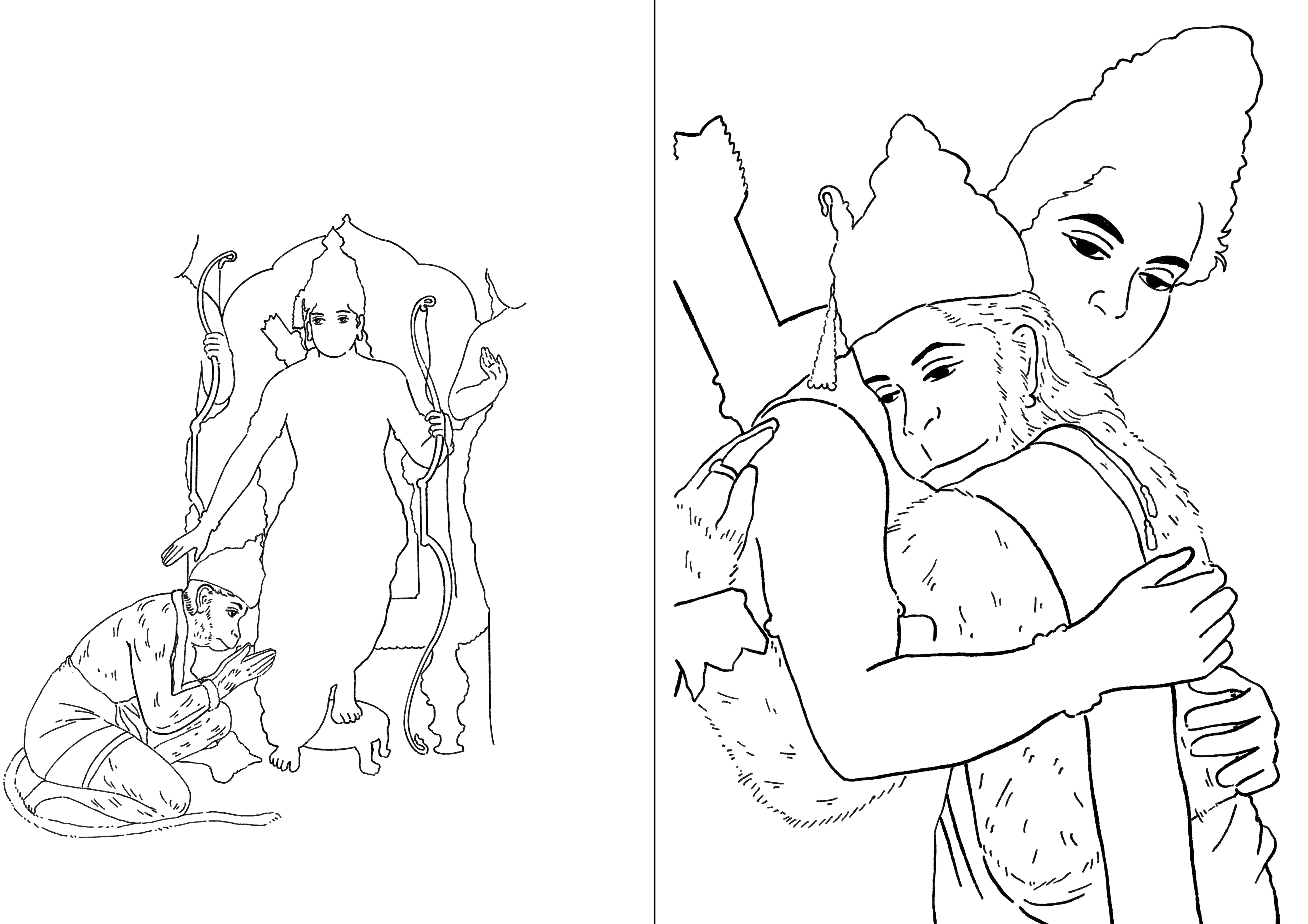
[17] Four studies in the language of the Veda, Jan Gonda (1959 Mouton & Co, The Hague, The Netherlands ) [THE “ORIGINAL” SENSE AND ETYMOLOGY OF SKT MAYA] & The Artful Universe: An Introduction to the Vedic Religious Imagination, William K Mahony (1998 State University of New York) [THE GODS AS ARTISTS: THE FORMATIVE POWER OF THE DIVINE IMAGINATION]
[18] Dasa-Sudra Slavery; Sharad Patil (Allied Publishers) [EARTH MOTHER, p83]
[19] Dasa-Sudra Slavery; Sharad Patil (Allied Publishers) — “Agricultural magic rests on the principle that the productivity of nature — of the female earth — can be induced or enhanced by the imitation or contagion of the human reproductive function” [CLAN-MOTHER TO TRIBAL MOTHER, p38]; “…tribal mother, who apportions the tribal wealth or land by lot-taking” [DICE AND AGRICULTURE, p65]; “Primitive agricultural people … believed that permanent sexual freedom to their women was assuring the fertility of the soil” […] “Regaining of virginhood every month also meant rejuvenation of youth. Hence, the mother goddess is conceived as eternally young … The purification and rejuvenation of the earth mother after she has ‘delivered’ her yearly harvest…” [EARTH MOTHER, p83-84]
[20] Same as [17]
[21] Rigveda 10.72; Translation: The Artful Universe; William K Mahony (1998 State University of New York) [THE GODS AS ARTISTS: THE FORMATIVE POWER OF THE DIVINE IMAGINATION, p19]
[22] Same as [17]
[23]
Indian Philosophy Vol1; S. Radhakrishnan — “The Brahmin tried to allegorise [read: appropriate] the myth and symbol, the fable and legend, in which the new tribes delighted. He accepted the worship of the tribal god, and attempted to reconcile them in Vedic culture.”[…] The Bharata [which later became Maha-Bharata] is the first attempt at effecting a reconciliation between the culture of the aryans and the mass of fact and fiction, history and mythology which it encountered.[…]The Buddhist scriptures were thrown open to all, while the sacred books of the Brahmins were confined to the three higher classes. Hence the necessity for a fifth Veda [referring here to the Epic of Mahabharata] open to all.” [EPIC PHILOSOPHY]
Caste Feudal Servitude Vol. II; Sharad Patil (Mavlai Prakashan) —The monopoly of Vedic study and its pre-condition of initiation being with Brahmana varna-jati in the new Srauta-Smarta religion [pre-Hinduism; Brahmanical ritualism] of the varna-jati system, it considered all non-brahmanas as Sudras. [FEUDALISM FROM ABOVE, p35]
[24] History of Early India: From the Origins to AD 1300; Romila Thapar (Penguin) — “Audiences gathered around the new philosophers in the kutuhala-shalas - literally, the place for creating curiosity - the parks and groves on the outskirts of the towns. This was a different ambience from that of Vedic thought where teachings or disputations were not held in public.” [5. STATES AND CITIES OF THE INDO-GANGETIC PLANES c. 600-300 BC — RELIGIONS AND IDEOLOGIES: QUESTIONS AND RESPONSES]
[25] The Asrama System; Patrick Olivelle (1993 Munshiram Manoharlal)[INTRODUCTION — THE MEANING OF SRAMA, p9; THE MEANING OF SRAMANA, p11]
[26] Same as [23]
[27] While the rise and fall of Buddhism, and resurgence of Brahmanical hegemony is also indispensably linked to rise and fall of Kings and Kingdoms, I have focused on the aspect of cultural and mythical appropriation. Romila Thapar’s book mention in [24] contains the information about Kings and Kingdoms as well.
[28] The Mirror of Gesture, Ananda Coomaraswamy and Gopala Kristnayya Duggirala (Cambridge) — “This matter of the Four Vedas should not be heard by Sudras, pray therefore shape another and a fifth Veda for all the castes.” [INTRODUCTION]
[29] Read more about this, and more on how anti-caste artists challenge and critique the hegemonic ignorance: Caste Life Narratives, Visual Representation, And Protected Ignorance; Y. S. Alone
[30] The Buddha and his Dhamma; B. R. Ambedkar — “being is becoming” […] “a human being can go on changing—becoming— while they are alive … because all is impermanent […] “all things … are produced by the combination of causes and conditions and have no independent noumena of their own” […] Consciousness is cognitive, emotional and volitional. [PART III WHAT IS DHAMMA?]
[31] Gender Trouble: Feminism and the Subversion of Identity; Judith Butler (Routledge) — “…the gendered body is performative… it has no ontological status apart from the various acts which constitute its reality” [IV. BODILY INSCRIPTIONS, PERFORMATIVE SUBVERSIONS] […] “The task is not whether to repeat, but how to repeat or, indeed, to repeat and, through a radical proliferation of gender, to displace the very gender norms that enable the repetition itself ” [CONCLUSION: FROM PARODY TO POLITICS]
[32] “educate, agitate, and organise”; this popular slogan comes from: EDUCATE, AGITATE, ORGANIZE, HAVE FAITH AND LOSE NO HOPE; B. R. Ambedkar; All India Depressed Classes Conference, Nagpur, July 20, 1942, and before that: AGITATE MUCH MORE, ORGANISE BETTER, THAN AT PRESENT; Dr. B. R. Ambedkar; The 36th Anniversary of the Sant Samaj Sangh; September 27, 1930
Piyush Kashyap
Email: kashyap.piyush@gmail.com
Website: zeropowercut.work